
Monday, September 13, 2010

Monday, September 6, 2010


Wednesday, September 1, 2010
Protection of students in ICT & games
This week's lecture presented us with some fairly confronting ideas as we were introduced to our responsibility for protecting students in the classroom from cyber predators, explicit content and cyber-bullying. This is a very real issue that can, and has, lead to unforeseen tragedies of social exclusion and even suicide.
Technology in the 21st century is a part of children's everyday lives in our society. These days it seems like you're the minority if you don't frequent sites such as youtube and facebook. these can be great sources of entertainment, research and education, and socialisation. But what about when children are not street-smart enough to protect themselves from damaging or explicit content? Who should be monitoring these children? Media coverage has ensured most people are aware of the ramifications associated with cyber-bullying and the explicit content of many many internet sites.Yet there is nothing in the technology that can stop children from visiting these sites.
When devising a learning curriculum that incorporates ICT, there are processes the teacher can undergo to ensure the navigation of sites will not lead to explicit content. this is an idea i have yet to explore hands-on, so im not 100% on how this works, but in my learning journey in becoming a classroom teacher find this to be one of the entities of teaching that is paramount for protecting our students.
It is our duty of care to protect our students, as Greg pointed out, this could be as simple as adequate classroom supervision.
Upon leaving the lecture i felt quite melancholy from witnessing the youtube video of a family's experience of losing their child to suicide as a consequence of cyber-bullying. So it was nice to learn that a focus of the workshop was to be on the construction of games and quizes to use as learning aides in the classroom.
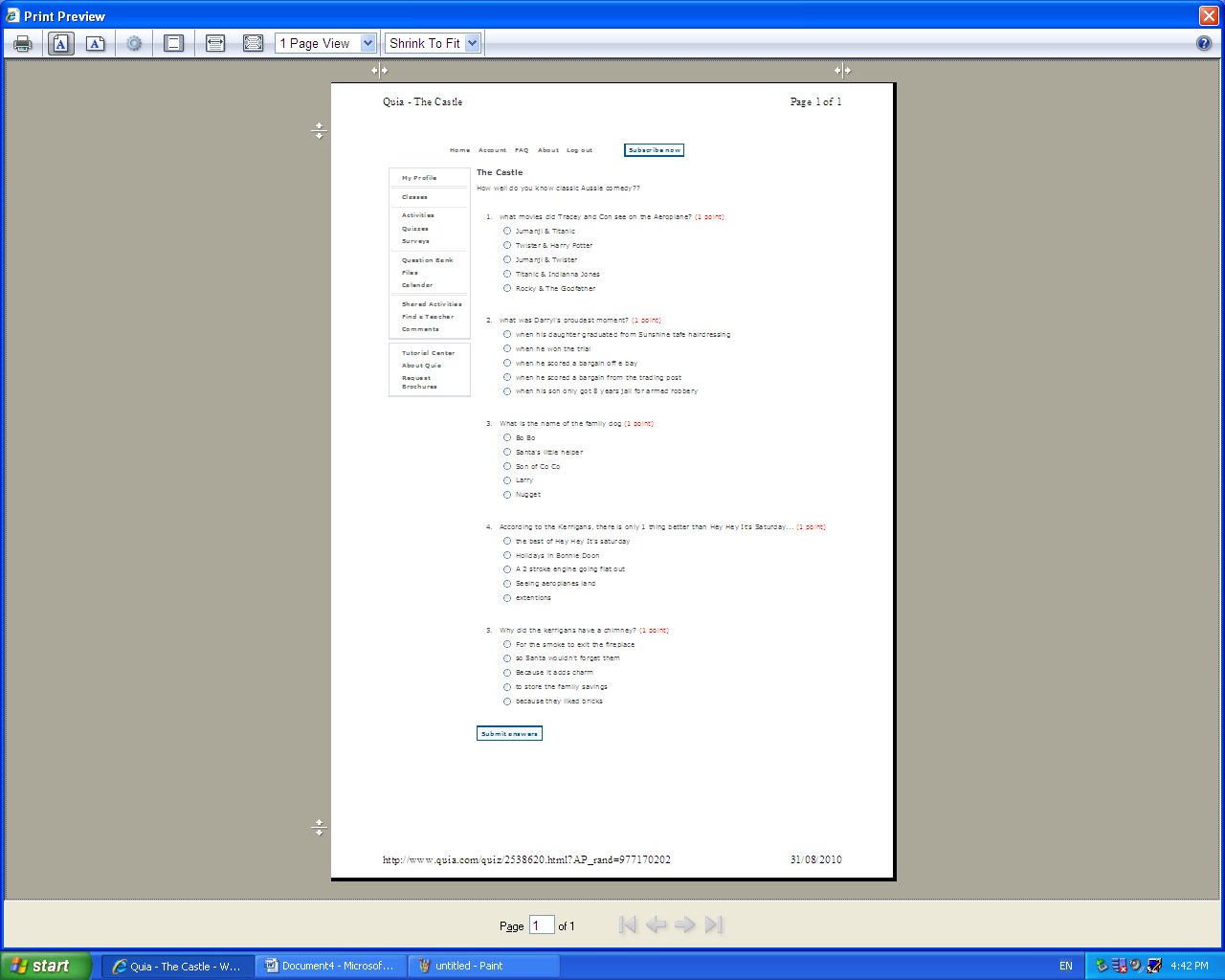
I was feeling a bit silly at the end of what was a long day of back to back classes, so created my example of a quiz based on Aussie comedy. chuckling to myself got me through the final stretch of the day, and i did in-fact grasp the concept of creating the program and believe it would be an effective learning resource in the classroom as it can be directed towards pretty much any learning topic.
Technology in the 21st century is a part of children's everyday lives in our society. These days it seems like you're the minority if you don't frequent sites such as youtube and facebook. these can be great sources of entertainment, research and education, and socialisation. But what about when children are not street-smart enough to protect themselves from damaging or explicit content? Who should be monitoring these children? Media coverage has ensured most people are aware of the ramifications associated with cyber-bullying and the explicit content of many many internet sites.Yet there is nothing in the technology that can stop children from visiting these sites.
When devising a learning curriculum that incorporates ICT, there are processes the teacher can undergo to ensure the navigation of sites will not lead to explicit content. this is an idea i have yet to explore hands-on, so im not 100% on how this works, but in my learning journey in becoming a classroom teacher find this to be one of the entities of teaching that is paramount for protecting our students.
It is our duty of care to protect our students, as Greg pointed out, this could be as simple as adequate classroom supervision.
Upon leaving the lecture i felt quite melancholy from witnessing the youtube video of a family's experience of losing their child to suicide as a consequence of cyber-bullying. So it was nice to learn that a focus of the workshop was to be on the construction of games and quizes to use as learning aides in the classroom.
I was feeling a bit silly at the end of what was a long day of back to back classes, so created my example of a quiz based on Aussie comedy. chuckling to myself got me through the final stretch of the day, and i did in-fact grasp the concept of creating the program and believe it would be an effective learning resource in the classroom as it can be directed towards pretty much any learning topic.
Monday, August 30, 2010
Saturday, August 28, 2010
reflection: Week 5
In this week's workshop we were asked to create a brochure for a holiday destination. The program we were to use was Microsoft Office Publisher and the content was to be a combination of our creative input and items from the internet by means of photos and information.
I am familiar with this program, having made brochures before; the program has many options for personalizing the presentation of information and I could imagine would be a teriffic way of encouraging students to navigate software and websites in a creative way.
In previous studies, i had a task that required me to create a 'Wellness' brochure for families of young children, a task that required a lot of professional research. Greg's assignment for us was of course the holiday destination brochure, a task that is more reflective of past experiences or interest directed. In a primary classroom the brochure activity can be integrated into a vast array of learning topics to suport many valued skills in primary education, including liteeracy, ICT, research skills, creativity and intrapersonal learning etc.
This week Greg introduced us to e-portfolios, what will count as our major assessment and what will no doubt be a large part of our primary classroom for assessment and reflection on individual student progress and achievement. An e-portfolio features multiple examples of students work in a student-centered digitalised collection of information both teacher and student governed that can act as a guide for future planning and a reflection for past skills and knowldege.
As a teacher-in-training i am well aware of the professional development journey i have embarked upon. Embedded in this journey will be the acquisition of ICT skills as described in this week's class as the following stages; Entry, where instruction is explicitly compreheded; Adoption, the mentoring stage of learning; Adaptation, tranferring knowledge; Appropriation, which involves peer to peer collaboration and Innovation, the final stage where skills are efined and 'coached' in interpersonal learning.
Ready...deep breath.....let's go!
I am familiar with this program, having made brochures before; the program has many options for personalizing the presentation of information and I could imagine would be a teriffic way of encouraging students to navigate software and websites in a creative way.
In previous studies, i had a task that required me to create a 'Wellness' brochure for families of young children, a task that required a lot of professional research. Greg's assignment for us was of course the holiday destination brochure, a task that is more reflective of past experiences or interest directed. In a primary classroom the brochure activity can be integrated into a vast array of learning topics to suport many valued skills in primary education, including liteeracy, ICT, research skills, creativity and intrapersonal learning etc.
This week Greg introduced us to e-portfolios, what will count as our major assessment and what will no doubt be a large part of our primary classroom for assessment and reflection on individual student progress and achievement. An e-portfolio features multiple examples of students work in a student-centered digitalised collection of information both teacher and student governed that can act as a guide for future planning and a reflection for past skills and knowldege.
As a teacher-in-training i am well aware of the professional development journey i have embarked upon. Embedded in this journey will be the acquisition of ICT skills as described in this week's class as the following stages; Entry, where instruction is explicitly compreheded; Adoption, the mentoring stage of learning; Adaptation, tranferring knowledge; Appropriation, which involves peer to peer collaboration and Innovation, the final stage where skills are efined and 'coached' in interpersonal learning.
Ready...deep breath.....let's go!
Sunday, August 22, 2010

Subscribe to:
Posts (Atom)